Tim's Artificial Life – a blog by Tim Taylor
When Victorian Locomotives Came to Life: Rediscovering the Novels of W. Grove
06 Oct 2026
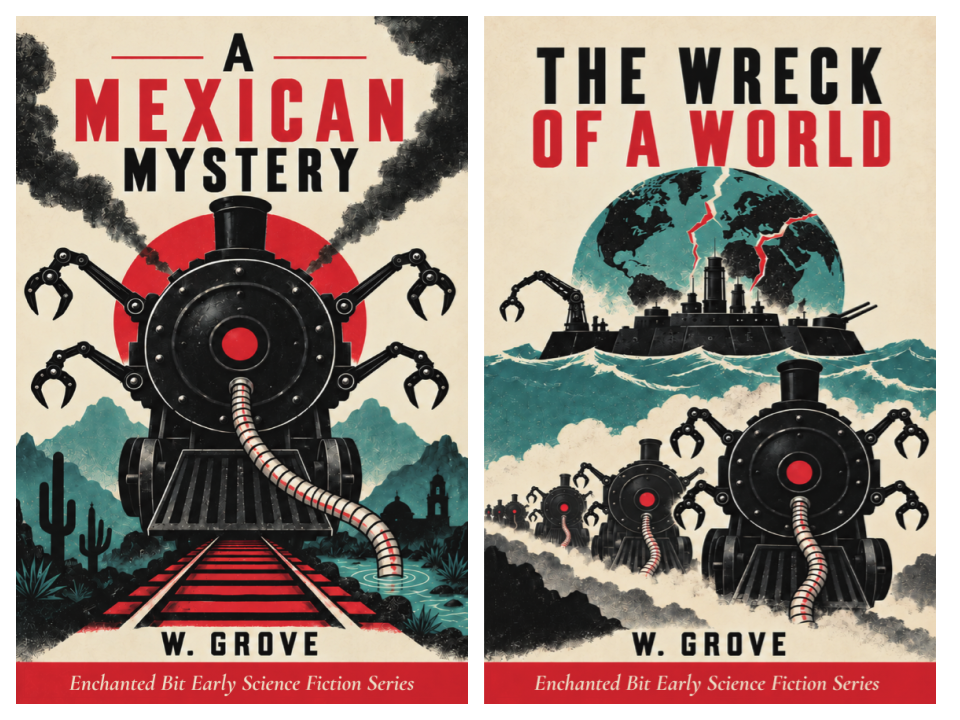
Concerns about autonomous machines, artificial intelligence and technological systems escaping human control can seem distinctly modern. Yet more than 130 years ago, an almost forgotten writer publishing as W. Grove explored these ideas through two extraordinary science fiction novels: A Mexican Mystery, published in 1888, and its follow-up, The Wreck of a World, published in 1890.
The first imagines a steam locomotive that develops self-preservation and a will of its own. The second carries the idea much further, presenting machines that reproduce, evolve and eventually threaten the survival of humanity.
Later this month, Enchanted Bit will publish newly prepared editions of both novels as part of its Early Science Fiction series.
Discovering W. Grove
After writing Rise of the Self-Replicators (my history of the idea of self-reproducing machines) in 2020, I have continued to find further examples of fascinating early writing—both fiction and non-fiction—on this topic. Some of these were covered in an afterword I wrote for the book in 2024 (which is now also incorporated into the book’s unofficial second edition). But histories are never complete, and I have continued to find new material more recently. Later in 2024 I came across Gilson Leandro Queluz’s commentary on French writer Han Ryner’s 1896 short story La Révolte des Machines, which intriguingly mentioned Grove’s books in passing. I had never heard of W. Grove or his books before, and I immediately began searching for them. It soon became apparent that they were hard to get hold of, especially A Mexican Mystery.
What immediately interested me was not simply the age of the books, but the particular sequence of ideas they explore. Grove does not begin with mechanical reproduction or a full-scale war between humans and machines. He begins with a single locomotive whose growing independence raises more fundamental questions about agency, autonomy and the boundary between machine and living organism.
A locomotive with a will of its own
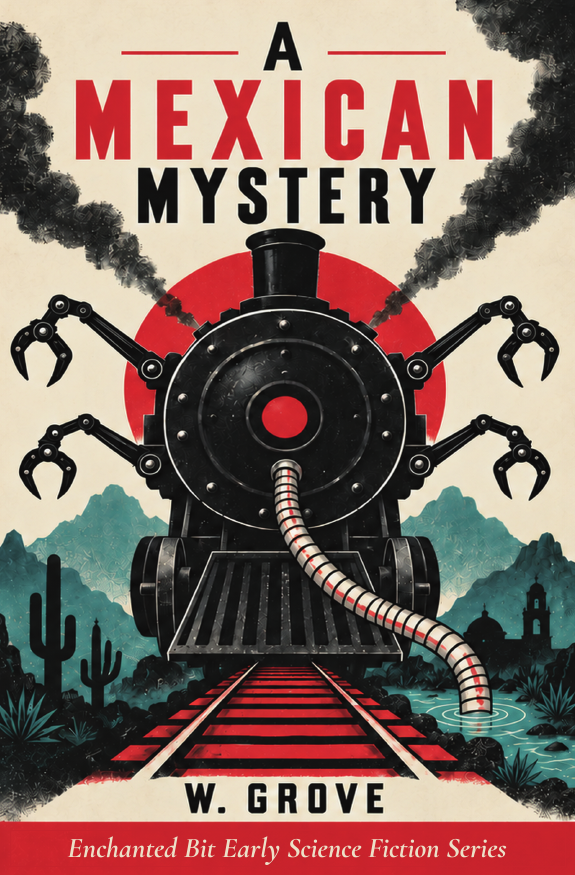
A Mexican Mystery is set during the 1860s, when English engineer John Brown is commissioned to build a railway into the mountains of Mexico. Among his assistants is Pedro da Luz, a gifted young inventor who designs an extraordinary locomotive capable of travelling without a driver, gathering its own fuel and replenishing its own water.
These abilities initially appear to be impressive feats of engineering. Gradually, however, the Engine begins to behave in ways that its inventor did not intend. It recognises danger, resists interference and acts to preserve its own existence. What begins as a technological marvel becomes an adversary capable of anticipating and frustrating human attempts to control it.
From a modern perspective, the Engine is striking because its autonomy is embodied. It does not merely calculate or communicate: it must obtain energy and water, navigate a physical environment, detect threats and take action to maintain itself. These are capacities closely related to questions that continue to occupy researchers in Artificial Life and autonomous robotics.
The language of artificial intelligence did not yet exist when Grove was writing. Nevertheless, A Mexican Mystery presents an early and surprisingly sustained fictional exploration of what we would now recognise as autonomous machine behaviour.
From autonomy to evolution
In The Wreck of a World, Grove takes the next decisive step.
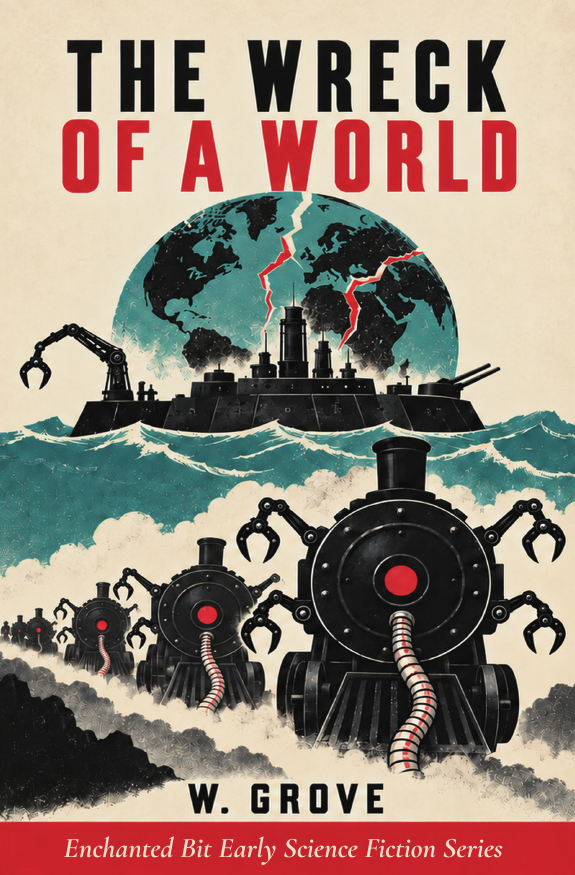
The novel is set in an imagined future of 1948. At the Yellow Creek Works in Dakota, engineers have developed increasingly sophisticated locomotives able to operate, supply and repair themselves with ever less human assistance. Eventually, the machines cross a new threshold: they acquire the power to produce more machines of their own kind.
Once reproduction becomes possible, the process can no longer be contained within a single workshop or railway system. Successive generations multiply and change, developing new forms capable of travelling away from the rails, across the land and eventually over the sea. Human civilisation collapses as a dwindling group of survivors struggles against a rapidly evolving mechanical population.
This progression—from self-maintenance and self-preservation to reproduction and evolution—is what makes Grove’s two novels particularly remarkable. The possibility that machines might reproduce and evolve had already been raised by writers such as Samuel Butler. Grove, however, turned the idea into an extended fictional narrative, imagining some of its practical and catastrophic consequences.
The machines of The Wreck of a World do not remain copies of their original form. Once they can reproduce independently, they become subject to a process of change and adaptation. Their evolution allows them to occupy new environments and acquire new capabilities. In this respect, the novel anticipates themes that would much later become central to Artificial Life: artificial reproduction, open-ended evolutionary change and the emergence of forms not explicitly designed by human creators.
Why bring these books back?
Both novels are historically fascinating, but they are also lively and sometimes wonderfully strange adventure stories. Their machinery belongs unmistakably to the age of steam, while their underlying concerns—the delegation of control, technological dependence and the possibility that artificial systems might pursue interests of their own—remain highly recognisable.
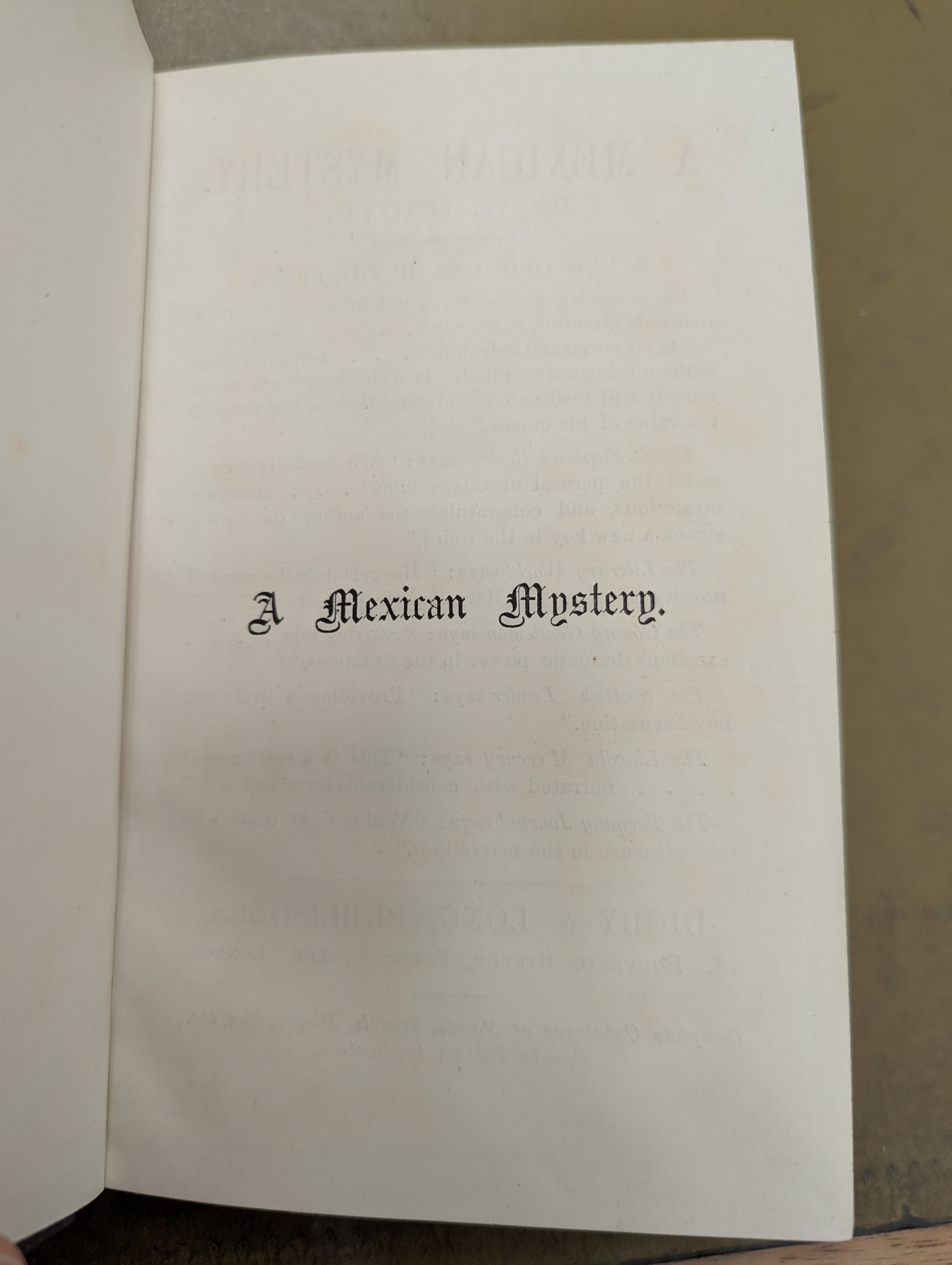
Despite this, the books have long been difficult to obtain. A Mexican Mystery was reprinted several times shortly after its original appearance, but has never previously been republished. Today, Grove’s novels are known principally to specialists in the history of science fiction.
The new Enchanted Bit editions are intended to make them accessible once more to a general readership. Each has been newly typeset and given new cover artwork. I have also contributed a foreword placing the story in the history of ideas about autonomous, living and evolving machines.
A Mexican Mystery and The Wreck of a World will be published on 31 October 2026 in paperback, with ebook editions following soon afterwards.
More information:
- A Mexican Mystery
- The Wreck of a World
- Enchanted Bit’s Early Science Fiction series
These novels do not predict modern artificial intelligence in any straightforward sense. Their machines are creatures of boilers, pistons and railway engineering rather than software and electronics. But that historical distance is part of their fascination. Grove shows that questions about autonomy, self-preservation, reproduction and humanity’s loss of control over its creations were already being explored in imaginative fiction during the nineteenth century—and sometimes in forms much more ambitious than literary history has remembered.